Sunday, July 8, 2012

Meeting Minutes


We had an engaging  and even contentious meeting today at La Madeleine’s!  We had a total of 4 attendees: (from left to right) Kevin Day, VJ Arjan, Jeff Harrington, and Tommy Schultze. 

Gratitude

Kevin kicked off the meeting by relating to us his experience growing up in a small town in Australia when running water and electricity were a luxury.  He told us how he had to ride a horse to school every day, which was a few miles ride.
Tommy then added that there is, in fact, an affirmative action law in Texas that preserves one’s right to ride on horseback to any given destination.
Viviendo en una Burbujaa (Living in a bubble), 2006

Relaying his experience implanted the seed of gratitude in our minds.  It is easy for the millenium generation to get caught up in the bubble of their world and to forget how incredibly fortunate we all are and to appreciate the technology that we have that makes our lives so much easier than they could be.

Perspective from Germany

Kevin just visited Germany and relayed that experience to us.  Interestingly enough, they are actually keen on saving the Euro although a much more despondent situation might change their viewpoints.

Surprisingly enough also, the Germans believe that President Obama is the greatest thing to happen to America in a long time and they firmly believe that he will win the next term.  It is ironic how the world’s impression of the President may differ so widely from the citizens themselves.

Jeff chimed in that the current crisis was almost built into the creation of the Maastrict treaty which did not have any provision for the current crisis as the creators felt it would force the countries into a political union.
VJ asked whether the current crisis in the Eurozone would create any investment opportunities in Europe for quality large cap companies.  Kevin mentioned Siemens (SI) as a good choice.  (I suppose Unilever (UN) would fall into the same category as well.)  Jeff however warned of risks with investing in companies that are either export-driven or are in banking as these firms will take a hit should Germany leave the Eurozone and move to a higher-value Deutchmark.

Lithium Miners
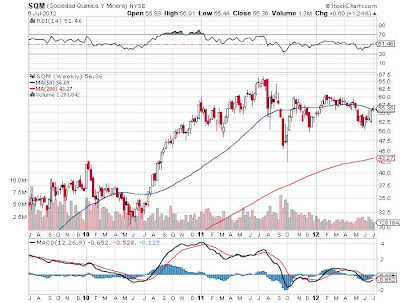
Jeff chimed in mentioning how the huge demand for iPads and other tablets has caused a spike in lithium mining companies.  Lithium batteries are also used in electric cars.  One particular miner he mentioned was Sociedad Quimica y Minera (SQM) which is up 225% in the last 5 years.

The speed of the emerging markets


Kevin mentioned the incredible speed with which the emerging markets are growing and building their cities.  A skyscraper usually took a few months to built, but recently and remarkably, a 30-story hotel was built in China in 15 days! Don’t believe me?  Take a look at the video above.


Presenting Akiro Kurosawa’s SFEG
The debate that ensued reminded me of Akiro Kurosawa’s Rashoman, in which the singular circumstance of murder is described wildly differently by each witness.

In this case, the single event is that Santa Fe Gold Corporation has recently taken a 50% hit to the stock price.  Below I present each person’s arguments.  I will leave it to the reader to make up their mind.

Jeff did an analysis of the company’s income statement and cash flows and determined that the company is not profitable in the core business of its mining operations and may be keeping afloat by its derivatives element.  The recent $15 million equity line just further proved to him that equity holders are being diluted further so that the company can stay afloat.  He made the dramatic conclusion that the company is therefore burning through cash and will declare bankruptcy.  I don’t believe he made any suggestions in regards to time frame.  As a result of this analysis, the stock price has sold off sharply.

Kevin believes that the conclusion that Jeff came to is absurd and he believes that this presents a great buying opportunity for the long-term potential to come.  The good earnings are yet to come.  From his estimates, the company is slated to earn a gross revenue of $40 million this year after the dish to Sandstorm.  If even half of that comes as net earnings to the shareholders at a price-earnings of 10, the stock should pop to at least the $1.50-2 per share range.  He believes that the company is far from bankruptcy and the stock is taking the hit due to some lone sellers.  He further believes that the company would not have received $15 million line had not the investors felt that they had done their due diligence and expected a full return on their investment. 

VJ agreed with Kevin mentioning the lack of volume to justify the enormous sell-off.  As anyone who has owned or traded SFEG knows, small purchases or sell-offs can generate huge swings in the price.  Although Jeff may have a valid point regarding the dilution of the equity holders, the main indicator VJ looked at was volume, which told him a different story.  In the last month, between 1.5 – 2 million shares were traded, which is about 2% of the total shares outstanding.  The insiders and major holders of the company apparently are not selling off.  So he believes that if many of the long-term holder’s are still in the stock, they must still believe in the potential therein.

There you go, readers.  You are free to put on your Sherlock Holmes thinking-caps and determine, rather deduce, how the case shapes up.

The rest of the year and more to come

VJ quoted Louis Navallier and Jim Rogers, the famous money managers, on their insight for the near-future.

Mr. Navallier, who did some historical analysis regarding market returns during the last six months of an election year.  He found that the average return since 1928 was 9.2%.  During an incumbent election year, that number is 12.6%.

He believes that chances are that the printing presses will continue for some time and the effect and risk of real interest rates being so low is that companies may begin to become more lax in addressing their balance sheet problems.

Mr. Rogers commented that there has also been a slowdown or recession of some sort in the U.S. every four to six years.  The current bull market began in March 2009, which means that if history is any guide, some time between 2013 to 2014, there will be a slowdown.  It will be interesting to see whether the economy will be able to stay afloat largely, and hopefully, without the buttress of the Fed.

The coming slowdown, however, can only reassure us of the case for commodities:
If the economy slowdown in quite drastic, as it may be unlikely that the government will increase taxes in this environment, the government will resort to the only thing it knows how to do – start up the printing presses again.  This can only lead to hard assets or commodities going higher.  The countries that will take the severest hit will be countries that have little natural resources.

If on the flip side, if the economic slowdown is not as bad as 2008 and the global economy begins to pick up steam again, the global demand especially from the emerging markets can only lead hard assets, particularly oil prices, much higher. In regards to oil prices, only one country has more proven oil reserves today than 10 years ago, and that is Brazil, so it is only natural that with supply at a standstill, oil prices must go higher.

While the dollar continues to be devalued, as it looks like will be for the near-term future, the stronger currencies will be the Swiss Franc, the Chinese Renminbi, and the Japanese Yen.

The broken window
Frederic Bastiat

“Economics is haunted by more fallacies than any other study known to man.  The inherent difficulties of the subject of economics compared to any other field of science, physics, mathematics, medicine, etc. Is the special pleading of special interests.  While certain public policies would in the long-run benefit everybody, other policies would benefit one group only at the expense of all other groups.” (Henry Hazlitt, Economics in One Lesson)
VJ brought up the interesting economic argument, first posed by French economist Frederic Bastiat, regarding a broken window.  A baker is going running his business one day, when all of a sudden a street tramp throws a brick through the window, shattering it to pieces.

The baker chase the vandal a block and returns gasping for breath.  By the time he returns, there is now a group of by standers gather next to the broken window.  One of them, an economist, mentions that at least the broken window will provide more business for the glazer.  The glazer will have to get the window from the glass manufacturer, and so on.  So he concludes to the group, that the broken window will create more economic value than we had before.  The crowd, seeing the logic of the argument, seems to agree and cheerily moves about their day.

What the economist did not know was that the baker was going to buy a suit, that he can no longer do to fix the broken window.  This new suit would have provided new business, for the clothing manufactuer, the retailer, and the tailor.  This, Bastiat, claims is real economic output.

For if the latter were the case, then it would be advisable to destroy and level our cities to the ground every few years so that there could be more economic activity.  Obviously, no one with common sense would do such a thing.

But such cases are made many times pulling a sheet over the minds of the masses.  For instance, the current President has repeatedly made claims that the additional entitlement programs he is putting into place will not increase taxes and will bring down the deficit over time. 

According to Hazlitt, the author of Economics in One Lesson, public spending can only be made with an equal and opposite effect on taxes.  If taxes do not go up, the only other way to spend more while taxing less is to start the printing presses, which actually creates an even larger deficit, which requires more money printing, so on and so forth.

So the next time, you hear the argument about increasing public spending, remember the broken window argument.


The next meeting will be on Sunday, August 5th, 2012. 

For those who have not attended a meeting, but would like to attend, please email your wish to VJ Arjan at scarletkings@gmail.com

Also I find that there are many domestic and international readers who are following our blog posts not only in the United States but all over the world including Europe, Latin America, and Asia. If you wish to be added to our email list, please email at scarletkings@gmail.com


Sunday, June 24, 2012

Next Meeting of the Scarlet Kings


Greetings to All,

The next meeting of the Scarlet Kings will be held on
Sunday, July 1st, 2012 at 12:30PM.

Location: La Madeleine's
(5290 Belt Line Road, Addison, TX)

Please join us for a fruitful and lucrative discussion!

Very Sincerely,

VJ

Tuesday, June 12, 2012

Meeting Minutes


We had an engaging meeting today at Chili’s!  We had a total of 6 attendees: (from left to right) Jeff Harrington, VJ Arjan, Elena Swindull, Ry Zamora (who joined us later) and one more who chooses to remain anonymous.  I want to thank Ry Zamora who made some very detailed notes on the extensive material covered during the meeting, which helped me very much in compiling the minutes below.  As there was a lot of material, some of it has been omitted to preserve brevity.


Facebook Fiasco and A Discussion on Bubbles


“Those who cannot remember the past are doomed to repeat it.” - George Santayana


It was quite evident that this topic would come up for discussion.  It is quite incredible how the public can get suckered into these schemes again and again.


In short, here is what occurred:


The initial public offering was set at $38 per share, which would put Facebook’s market cap at $100+ billion.  During the last year, Facebook reported earnings of $3.7 billion, and there were major revisions, upwards to 10%, to its growth prospective merely a week or so before the IPO.  The bottom line was that it would take the investor 100 years to breakeven on the initial investment at the initial public offering.  The stock subsequently sold off close to 40% in the weeks after.


And who might we ask was selling their shares?  Goldman Sachs, Morgan Stanley, and many of the insiders, including Mark Zuckerberg, unloaded a majority of their stake onto the public.  Mr. Zuckerberg sold $5 billion worth of his ownership interest.  Interestingly enough, according to a Reuters article (http://blogs.reuters.com/felix-salmon/2012/05/22/the-facebook-earnings-forecast-scandal/), the public probably doesn’t know that Mr. Zuckerberg also deliberately created a dual-class share structure to ensure that they (the shareholders) can be completely ignored on all decisions.


Elena mentioned that this is not to knock that Facebook may indeed be a leader in the social media industry for many years to come, but the hype, in this instance, perhaps, superseded the reality.  Jeff even suggested how Facebook could become an evolution of our current system of government - a social government, if you will.

The group then had a discussion on bubbles and how the public fails to see them coming time and again.  


Elena Swindull and Jeff Harrington explained how the tulip bubble in the early 17th century in Holland is proof how ignorant people are willing to gamble away their life savings on the promise of fantastic returns on an instrument they do not completely understand.  The truth of the matter is that as great an investment Facebook may pose, the old money was suckered in, got duped by the promise of exponential returns, by an investment they did not completely understand.


VJ Arjan bought up the South Sea Company bubble in 18th century France, which was the Enron of old on a much larger scale.  For more historical details about bubbles, please read Extraordinary Popular Delusions and the Madness of Crowds by Charles MacKay.


Mythbusters: Sell in May and Go Away

As we all know, the market wiped out the year’s gains in the month of May and it is now actually at a negative return YTD.


This prompted VJ Arjan to explore whether there is any truth to the market aphorism.  Here is what he found analyzing data on the Dow Jones Index since 1968.


In 44 years:
- 21 had positive returns with an average gain of 148
- 22 had negative returns with an average loss of 146


The data is compelling in that although there is not major loss in the month of May, there is also no gain.  So the tentative conclusion is that it is the month of May seems to be a wash.


That being said, Jeff Harrington pointed out that the historical returns from the periods October to April, are significantly better that those from May to September.


JP Morgan Trading Loss


On May 10th, JP Morgan Chase reported that it had accumulated a trading loss of at least $2 billion.


The stock subsequently dropped from $40 to the low $30, wiping out approximately $30 billion in market capitalization.


VJ Arjan asked whether this might be an overreaction as it is hard to justify a $30 billion loss in market cap even if the worse-case scenario were the loss was $5 billion. Jeff Harrington cautioned that the loss was on interest-rate swaps and these instruments are the equivalent of a financial atomic device were an institution on the wrong side – it is prudent remember Lehman and Bear Stearns.  He believes it is best to lie low for a while and wait for the dust to settle before getting into Chase.


Ry’s experience in China


Unbeknownst to any of us, Ry has actually visited China several times.  We asked him to relay his experience with a host family over there.


In his estimation, much of the conversation amongst the Chinese revolves around how to accumulate money – they are very wealth-creation driven and very entrepreneurial.  They admire and try to emulate the Americans and are very inquisitive about American culture and lifestyle.


Personal space is a concept that is less important in China than it is in the US.  A Westerner might find that if one were to take a step back, the Chinese might just step closer.  There are also not big on the concept of lines.


Ry also talked about “spit culture”.  It is, in fact, normal for the Chinese to spit when they feel like it.  It is not considered disrespectful, but is simply a way of life for them.


The Euro’s Final Act


“To be or not to be, that is the question: Whether ‘tis Nobler in the mind to suffer the Slings and Arrows of outrageous Fortune, Or to take Arms against a Sea of troubles, And by opposing end them” - William Shakespeare, Hamlet


We had a lengthy discussion about this global crisis.  George Soros recently made the remark that the Euro has another 3 months to go before it will completely collapse should a financial arrangement of the PIIGS not be made.


The problems of this Euro arrangement are plentiful and they have been discussed in this blog before:


Jeff mentioned how Spain’s pension system allows expatriates to possess a dual citizenship and still take advantage of the federal pension system, even though they do not pay taxes to the Spanish government.  Ryan chimed in stating that this can only lead to further money-printing, which would eventually lead to hyperinflation.  However, he did point out that Spain’s crisis might be much worse than say the hyper-inflationary period in Mexico or Argentina because Spain does not have any substantial natural resources it could use to contain the hyperinflation.


Greece is unable to raise money in the debt markets, and the yield on their debt continues to surge.  All bets are on Germany lifting these betroubled countries out of their fiscal mess as Atlas carries the world upon its back.  Jeff talked about how yields for the German sovereign debt were negative, meaning people were paying just to get the principal back. As a result, the Germans are virtually receiving free money, which provides further incentive to spend freely and proceed with bailout policies.  On the flip side, this also provides an incentive for Germany to leave the Euro behind, as this could not go on indefinitely.


With all the money coming into the safe havens of U.S.Treasuries, Jeff mentioned the TLT (T-share 20 year yields). It is an ETF that might present a profitable short since the rise of bond prices.  If the economy should recover, the result will be a drop in bond prices as yields rise once more.


Ryan’s Analysis on the Euro Crisis


Ryan had a particularly articulate well-thought out diagnosis of the Euro crisis, which I present below, except a few edits, verbatim from his own notes:


His observations and research on the unfolding crisis shows that the Euro crisis revolves around four factors: (1) accountability, (2) acceptance, (3) teamwork, and (4) value. He explains it as such:
o Accountability: people must recognize that there is a culprit behind the crises. It doesn't have to be tagged to any specific individual or group of people - it could be a trait. For example, complacency in fiscal discipline, culture of entitlements and government-given spoonfeeding. 
o Acceptance: while many informed citizens are aware of the real problems, the politicians still must accept that the problems are not fiscal/monetary, but deep-rooted in cultural and/or fundamental concerns. 
o Teamwork: if this is followed by teamwork, then this means ceding political sovereignty -- to some extent, freedom -- to a figurehead. It also means one nation's unity towards a certain action (consider that Greek politics are fragmented into at least five parties)


o Value: but whatever the choice, the only thing that can save the nation in question is a unique value proposition. Without it, poverty or dependency ensues. Greece can gamble on tourism. Ryan does not know what Spain, Italy, or Ireland has.


In a talk with VJ after the meeting, Ryan talks about how the humanist point-of-view is even more important now that the crisis has taken the events out of the economics textbooks' jurisdiction.


Change of the Seat of Power


(The Fall of Rome)

Ryan brings a change to the conversation, introducing a subject on cycles - how the seat of power has changed over the past few millennia.


First came Mesopotamia, then Egypt, then Rome, then the European era of dominance (particularly Spain and Britain), and then America. Now, it looks like it's shifting to China.  
As the saying goes, what goes around comes around, and now we are full circle.


Jeff explained how 500 years of European hegemony as the world power shifted in 1991 with the fall of the Soviet Union and moved a couple thousand miles east to Asia.  He also mentioned how many countries in Europe, primarily the PIIGS, haven’t woken up to this fact, and the experience now for the Europeans is similar to being hit with the bag of bricks upon the head as a heavy dose of reality.


Jeff also explained how emerging empires largely stole the technologies from other existing empires and built and improved upon them to emerge dominant.  Such is the case halfway around the world with the current problem of the piracy of intellectual property.


VJ also explained how it seems that the abuse of credit is a singular factor in the decline of a reigning empire.  This is especially discussed in Gibbon’s The Fall and Decline of the Roman Empire as a key factor along with a host of others, as being of principal importance in its collapse.  Also as part of his observations, he noted that the problem of deficit spending for the Romans was denied for quite a long time, and by the time they had recognized the severity of the problem, it was too late.  Looks like the U.S. may be headed in the same direction.


A Bear in India


While China is flying up the economic and political totem pole, India, at least In VJ's opinion, has it dead wrong.  VJ started talking about the problems of India in his estimation:

Unlike the Chinese who were united by Emperor Shi Huang-Di of the Qin dynasty for 2 millenia, and who remain united according to very similar borders today, the Indians have been so divided as a country that it took the British to come along and occupy their territory for 250 years before there was any real semblance of unity. 


To this day, there is constant competitiveness and social class warfare amongst their own people. This extends especially to their bureaucracy, which by some estimates is the worst bureaucratic system behind Egypt; a system designed by the British empire to favor the upper class and aristocracy and make life more difficult for those coming up the ranks.  They also have the second-worst road and telephone system in the world, second only to Haiti.

There is a superiority complex when it comes to culture and intelligence.  This is one reason that countries isolate themselves and actually end up not progressing because the fail to see the beam in their own eye.  Openness breeds creativity and innovation, closeness breeds the opposite.  For proof, look at North Korea and Myanmar.


At the most fundamental cultural level, a crab mentality exists, along with a cultural habit of exploitation for one's own desires.  For proof, the Indian government has recently been swamped with one political scandal after another, some of which directly implicate the current Prime Minister, Manmohan Singh.


Long-run emerging companies


Here are a few companies that were brought up during our meeting that are looking like companies in emerging industries that have great long-term growth potential:


  • Tesla Motors (TSLA)
  • SpaceX
  • HOLCIM (HCMLY)


The next meeting will be on Sunday, July 1st, 2012. 


For those who have not attended a meeting, but would like to attend, please email your wish to VJ Arjan at scarletkings@gmail.com


Also I find that there are many domestic and international readers who are following our blog posts not only in the United States but all over the world including Europe, Latin America, and Asia. If you wish to be added to our email list, please email at scarletkings@gmail.com

Saturday, May 26, 2012

Next Meeting of the Scarlet Kings


Greetings to All,

The next meeting of the Scarlet Kings will be held on
Sunday, June 3rd, 2012 at 12:30PM.

Location: Chili's
(4500 Belt Line Road, Addison, TX)

Please join us for a fruitful and lucrative discussion!

Very Sincerely,

VJ

Wednesday, May 23, 2012

Fiasco at JP Morgan Chase by Jeff Harrington

So, this did blow up in Jamie Dimon's face. I am impressed by two things.
  1. The speed with which it occurred.
  2. The losses that have been incurred thus far: $2 billion, which is $1 billion (100%) more than what Dick Bove estimated. 
This is not what the market wants or needs to hear. Given that total losses are unknown, I am seriously thinking that if one owns JPM's stock that they should get out until the dust settles. I am very much so concerned that Dick Bove was off by so much and since the man on top has no idea, I can't help but feel like we are staring into another abyss; real or not. I understand this may be viewed as an overreaction, but I don't think it is because we just had one of the largest credit and banking crisis's in modern history and within four years the largest, and arguably the most important bank, is back to gambling like a casino.  Do we really need to burn the house down to the ground in order to learn our lesson? Come on guys!

What is the lesson I am referring to?

Banks exist solely to match net savers with net borrowers, to hedge against the risk of default between the two, and to accept all of the downside through those losses while only being entitled to the limited upside of the interest spread. Sure, they can charge fees on other services to enhance revenue. But no more speculation and gambling. And let me state this, I do not believe that JPM was engaging in bon-a-fide hedging, because I doubt there would have been such excessive losses, if any, i.e., hedging. So, I conclude that JPM was gambling and trying to prove to the government that they knew what they were doing and that FinReg was an overreaction that needed to be watered down or repealed. Derivative speculation is not a viable business model from which a bank earns its revenues. That is a highly risky and highly volatile business that exists to hedge against legitimate risks. I know that traditional banking is not 'sexy', but it never was meant to be. Executives hate this because there is no 'sexy' upside via bonuses and lucrative stock options (I suspect bank stock returns would theoretically be tied to GDP growth and interest rates under this scenario). Banks can make money without really having to do or innovate anything. All you really need to run a bank is a computer, and maybe an ATM machine for anyone who still uses cash (not being snarky here, but more and more transactions are occurring via plastique). Innovation is a difficult task as it is and so the real risk takers get to take that challenge on by creating new businesses and innovating - and either being rewarded with huge upside or punished into bankruptcy. In other words, banks are not supposed to be innovators (or gamblers) of anything, just risk hedgers and, like a bookie (who never bets on any one game), they take the interest rate spread (grease). Being a bank is pretty easy and very profitable if you're good at it. This is purely an academic statement and yet we allow banking executives to subject us to this crap over and over again.

Whatever argument Dimon had against the regulators, and I would argue that Dimon was leading that pack when he did this, he just lost it...for good. That is what having egg on his face means. But note, I was never taking the stance that the point was whether or not this blows up in his face, but if the government does anything about it based off FinReg. Especially in an election year cycle. This may actually boost Obama... How much? I don't know. Again, JPM is a big bank that can stomach a lot and it depends on how bad the losses really are and how much the market makes of it. But, the media saw this one coming, reported on it, and the regulators did nothing...Smooth. Obama will argue that he is not to blame because the teeth on financial regulation were removed. The Republicans will argue that current regulation is enough and that the regulators were asleep under Obama's watch with the so-called enhanced FinReg, which they will then use to argue that there is too much regulation and that it is not working. Let the circus around this begin.

Both will have valid arguments I think, but the fact is that Glass-Steagle needs to come back in its full glory; that is to say, prevent banks from gambling with both their own money and their clients money. From there, we can probably scrap most other banking regulation with the exception of fair lending standards and fair credit reporting. I am not anti-capitalistic in saying this. But, quite the opposite. A healthy economy is absolutely dependent upon a healthy banking sector; If you blow up the banks, then you blow up the economy. Note: if Glass-Steagle is re-enacted, this will force JPM to break up - the Investment bank will we stripped off the company and formed as a separate entity. This will be a political hot potato. But, the banking executives have proven that they cannot handle the two diametrically opposed businesses well...twice in the last 4 years and more so over the long run.

The irony is that this has been my one and only major fear in the market over the past few months - that we are getting out of the crisis and the big banks are going right back to the slot machine to gamble everything away again. I am not too happy with this. Though, I erroneously believed that JPM knew what it was doing. Maybe it was because I am a former employee and was impressed with the team that I worked with (they were in the custody side of the business - trillions and trillions of dollars...not just billions).

http://www.bloomberg.com/news/2012-05-11/jpmorgan-loses-2-billion-as-mistakes-trounce-hedges.html?cmpid=yhoo

P.S. It wasn't a mistake for Dimon if he had been right and won. IT was greed. This will need to sting in order for him to learn. I know this from experience. And, I hope to god that this is simply a hic-up and not a full blown tempest that, when I er-read this to check for errors, I am fearing that this may be. But, I wonder if anyone else was out swimming naked. I would rather appear to be a blow-hard who is taking too much credit, than I would in being right. Because, if I am right then we all lose.

Sunday, May 13, 2012

Meeting Minutes


We had a wonderful meeting today at The Olive Garden!  We had a total of 6 attendees: (from left to right) Nathaniel Taylor, Elena Swindull, VJ Arjan, Jeff Harrington, Kevin Day and one more who chooses to remain anonymous.

The Recession to Come

It is a historical fact that a recession or a slowdown of some sort has occurred in the US roughly every 4 to 6 years.  Also, the average bull market lasts about 2 ½ years.  The current bull market that took off in March 2009 has now lasted about 2 ¾ years.  It is therefore conceivable that some slowdown can be expected in the near future.

We all had a discussion on how this would play out.  There was relative consensus that the downturn would wait until after the election has been secured.  There has only been 3 occasions in history when the market indices ended up negative during an election year, one of which was 2008.

Asked whether the coming recession or slowdown would be worse than the last one, Kevin Day answered that he did not see the slowdown as significantly worse.  It still may be one to reckon with, but not with the same severity as the last one.

Although there is some opinion amongst the board of the Federal Reserve that is opposed to QE3, Kevin noted that there was little doubt that it would occur at some point.

Leverage

The exponential rise of the 1% has been mainly possible directly due to the availability of credit for leverage.  Here is a case in point:
-       In the 1970s, there was 1 billionaire, Mr. Ludwig, an America shipping magnate
-       In the 1980s, there were 8 billionaires, a majority of them oilmen riding on the coattails of the rising price of oil
-       Today, there are publicly and privately, estimated to be 1,500 billionaires.  About 30% have inherited their wealth.

Below is a graph that illustrates what is occurring:


(R. Pollins, The Contour of Descent)

While the wave of technology has increased productivity, adjusted for inflation, real wages have gone down relatively speaking for the last four decades.  
(Mother Jones Magazine, based on data from the U.S. Census Bureau)
The greatest absolute impact of the Great Recession of 2008 was upon the 1% that had gained their wealth with the help of massive amounts of credit.  The de-leveraging process that occurred post-2008 was the cause.

The resurgence of Populism


VJ Arjan noted how history has a tendency to move in cycles and that the current cycle could mirror the Populist movement that started in the last 18th century and lasted up to the presidency of the “trust-busting” Theodore Roosevelt.


The Gilded Age, the era that preceded the Populist era, created the world’s first billionaires and centi-millionaires, including John D. Rockefeller, Andrew Carnegie, John Pierpont Morgan, and Jay Gould.  During that era, the average blue collar worker worked anywhere from 10 to 16 hours per day, while not seeing any significant rise in their wages.  


The rebellion of these workers formed the labor unions that still exist today, demanding fair pay and a lighter work schedule.  These were necessary reforms of the time.


Perhaps, today we are seeing this same reforming of the labor market pan out with the mass demonstrations in Greece and Spain and the Occupy Wall Street movement in the US.


So, therefore, if history is any guide, perhaps we will be moving into a new normal for many years to come with more and more reforms to the labor market.

European Basketcase


There are many watershed events occurring in Europe that do will shape the future of the European Union for many years to come.  


The Euro has certainly not responded well; below is a chart over the past month. 


France
Jeff Harrington discussed the policies and persona of the new French president, Francois Hollande.  His election only puts more pressure on the European Union as he ran and got elected on a platform that directly opposed taking on further austerity measures. As Jeff put it, some of his economic policies put “the Left” to shame.

Jeff also mentioned how it would be increasingly difficult for France to remain as a part of the Union as their forecasted debt-to-GDP levels would continue to violate the Maastrict Treaty.  Of course, France is not the only one that has violated these levels, all of the PIIGS have far surpassed the minimum 60% debt-to-GDP levels laid out in the document, but they are all participating in severe austerity measures in an effort to return to the 60% level specified in the treaty.

He also has the reputation of not taking orders very easily, which would make it very difficult for Merkel who has come out as the head-in-charge of this Euroland rescue operation.

Spain
(The Puerta del Sol square in Madrid)
Last week in Spain, a staggering 100,000 “indignants” crowded the streets of Madrid in protest of the dismal economy and austerity measures that are being undertaken.  The unemployment rate has recently hit a record 23.6% most of which are college graduates under the age of 25.

Greece
With mass unemployment, inflation at roughly 50%, and government paralysis in dealing with the issues has prompted serious discussion for the first time that the best course might be for Greece to exit the Eurozone. This would instantly wipe out the bondholders who own Greek debt and lead to disastrous consequences for Greece when they issued a badly deflated currency, perhaps reissuing the drachma.

Eastern European countries
Surprisingly, the newer market entrants to the Eurozone, like Poland and Romania, are performing much better than their “more advanced” Western European counterparts.


Elena mentioned how the Slovak countries have done extra-ordinarily well after their entrance into the Euro.  Jeff added that this is partly due to the relatively conservative economic leverage levels that they have sustained and also because production and manufacturing capacities, particularly for auto manufacturing, are being shifted from Western to Eastern European countries.

Flow of money

Jeff noted that money has a tendency to flow from one asset class into other asset classes.  At the present moment, he feels that the smart money is flowing out of Europe and the emerging markets and into the U.S. in hard assets like commodities and real estate.  He particularly suggested looking at farmland if you can find it cheap enough, as farmland is appreciating rapidly.

Beware the high yield dividend

Kevin mentioned that just because a company is paying out a high dividend, does not mean that it is a safe investment.  Jeff mentioned that often times a company will do this to exit a dying industry.


Of course, VJ didn’t know this when he invested in Cellcom Israel, which was touting a 12 percent dividend yield.  He figured that because Cellcom is the biggest cellphone provider in Israel and cellphones aren’t going anywhere for a while, it would be a safe investment.  

Here is what happened to the stock recently:
VJ pointed out that apparently due to some regulatory restrictions and increased competition, the profits would be sharply diminished.  The stock has dropped 60% in the last year.  It still touts a 12% dividend, but on a significantly reduced stock price.

The lesson here is to look at the whole stock before investing, instead of getting caught on the lure of a dividend yield.  If there is a high dividend yield, it may be prudent to ask why the yield is so high.

Market plays

Here are some market plays that were bought up during the meeting:


-       Brigus Gold (BRD) - A Canadian junior gold miner
-       Sandstorm Gold (SNDXD) - Negotiates contracts with gold miners for a percentage of 
the profits; up 50% in the last year
-       Westpac Bank (WBK) - Australian banking corporation with a 7% dividend yield
-       Aberdeen Asia Fund (FAX) - a no-load income fund that invests in Asian debt securities
-       iShares Preferred Stock Index Fund (PFF) 
-       Siemens (SI) - a multi-national conglomerate


The next meeting will be on Sunday, June 3rd, 2012. 

For those who have not attended a meeting, but would like to attend, please email your wish to VJ Arjan at scarletkings@gmail.com

Also I find that there are many domestic and international readers who are following our blog posts not only in the United States but all over the world including Europe, Latin America, and Asia. If you wish to be added to our email list, please email at scarletkings@gmail.com